
You've probably noticed it. An email lands in your inbox from a colleague or a vendor, and something feels off. Too polished. Too many em dashes. Overly enthusiastic. Slightly sycophantic. You think: this was definitely written by ChatGPT.
According to a 2025 Salesforce survey, 72% of consumers say they can detect AI-generated content, and 52% say it makes them trust the sender less. That's a problem if you're using AI to write prospect emails, client updates, or marketing content.
But here's the thing. The problem isn't AI writing. It's AI writing without your voice.
Why readers spot AI-generated writing in seconds
People don't need a detection tool to spot AI-generated text. The tells accumulate fast. Overuse of em dashes and alliteration that sounds like a poetry exercise. That slightly fawning tone where every idea is "fascinating" and every solution is "powerful."
Then there's the structure problem. AI loves neat groups of three. It builds predictable parallel sentences and reaches for words like "crucial" and "leverage" that most humans stopped using years ago. The rhythm is the giveaway. Everything comes out the same length, the same weight, the same shape.
Send a prospect an email with those patterns and here's what they think: you didn't care enough to write it yourself, and you're not paying attention. That erodes trust before you've even had a conversation.
Here's what the difference looks like in practice. Generic AI, no voice profile:
"Leveraging our innovative, synergistic approach, we've cultivated a transformative ecosystem designed to drive paradigm-shifting outcomes for your organization."
The same message, run through a voice profile built for direct, jargon-free communication:
"We've built a system that cuts three hours of manual reporting down to fifteen minutes. Here's what it actually does."
Same information. Completely different effect. The first one announces itself as AI. The second one sounds like a person who knows what they're talking about.
"If people can tell that you used AI, you need to disclose that you're using AI. Because when you send a prospect or client something that reads like a robot wrote it, they feel like you're being lazy or that you didn't put in the effort."
— Mike Schwarz, Founder & CEO, MyZone AI
What an AI voice profile actually does
A voice profile is a detailed map of how you write. Not what you write about, but the patterns underneath. Sentence length, directness, your default level of formality, the phrases you lean on, how you open and close messages.
To build one, AI analyzes your existing writing across multiple channels. Emails, Slack messages, Google Docs, meeting transcripts, LinkedIn posts. It needs roughly 30 to 50 samples to get an accurate baseline.
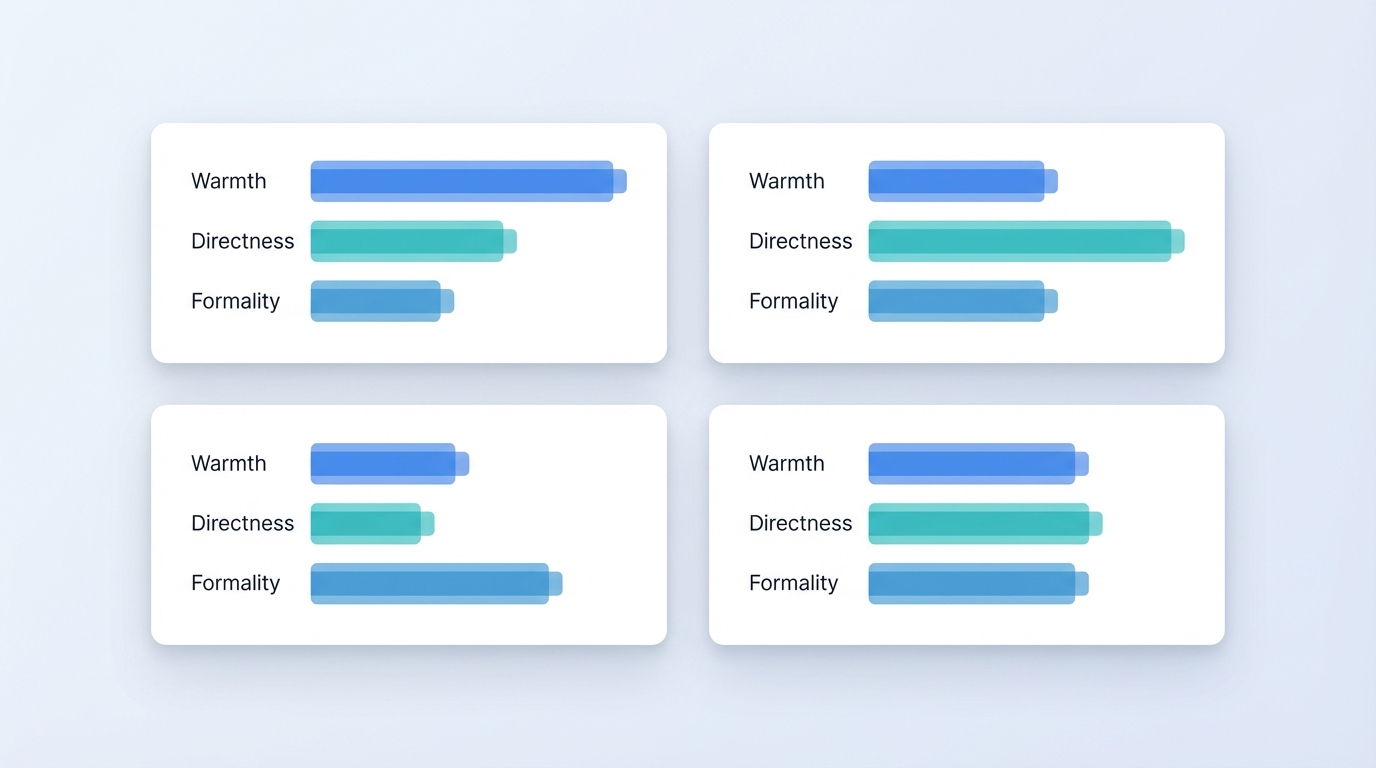
The system measures dimensions most people don't think about: warmth, directness, humor frequency, vocabulary complexity, argument structure.
Then it locks those patterns into a reusable profile. When you ask AI to write something on your behalf, it applies your profile instead of defaulting to generic ChatGPT-speak.
Three minutes of rambling, two hours of output
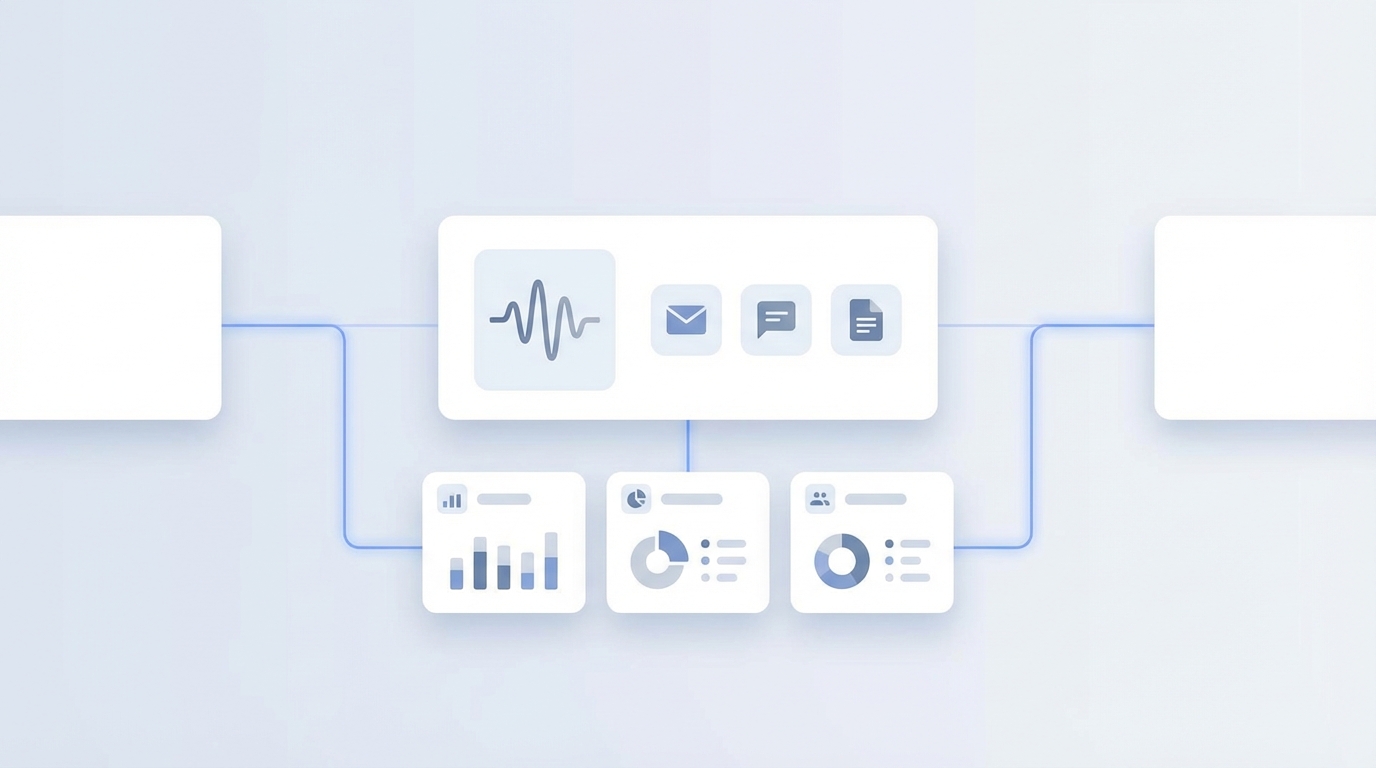
The part that keeps surprising me is the ratio. I do a three-minute voice interview where I answer a few questions about whatever I'm writing about. I basically ramble into a microphone for four minutes.
The AI takes that interview, combines it with my voice profile and the relevant assets, and produces a complete article.
I've written 2,500-word articles this way. I narrated the outline, the thesis, a couple of key quotes, and the executive summary. The AI filled in everything else. And when I read the finished piece, it reads like I spent two hours writing it.
I didn't. I spent four minutes on an interview.
How it works in practice
For every article on the MyZone blog, the process is: a 3-minute interview to capture quotes, direction, and structure. Then the AI uses the voice profile, page templates, and related skills to produce the full article in about four minutes. The human provides 20-30% of the total content through the interview. AI fills the rest, sounding like the person who did the interview.
Voice profiles for every person on your team
This isn't limited to a single writer. We set up different voice profiles for everyone in a company. When anyone on the team uses the Ai1 platform, it knows who they are. If a marketing lead says "write a blog article on my behalf," the system grabs their voice profile. If a sales rep drafts a client email, it uses theirs.
Each person gets custom author cards, custom voice settings, and content that reads like they personally wrote it. Right now our blog only has my voice because I built this site quickly to test the platform. But soon you'll see multiple contributors here, each with their own distinct voice, and none of them writing more than 20-30% of the total article manually.
Your authentic voice might not be good enough
That sounds funny, but hear me out. Voice profiling doesn't just capture how you write today. It can actively improve how you write for specific situations, and that's the part most people never hear about.
A salesperson's natural writing voice might be fine for internal Slack messages but underperform for prospect outreach. You can create an enhanced version tuned for higher conversion rates. A manager dealing with sensitive one-on-one conversations might want a variant with boosted empathy. Someone writing thought leadership might want a more authoritative register than they'd use day-to-day.
So you end up with multiple voice profiles for different contexts:
- Professional voice for client communications
- Personal voice for internal team messages
- Sales voice optimized for conversion
- Empathetic voice for sensitive one-on-ones
- Thought leadership voice for articles and posts
Most people don't realize any of this is possible, because they assume voice profiling means one static snapshot you configure once and live with. It's a tunable system, and that changes the calculus completely.
What businesses get wrong about AI writing
The first mistake is giving up too early. Someone tries ChatGPT, reads the output, decides it doesn't sound like them, and walks away without realizing that voice profiling is the exact solution to that problem. What comes out of ChatGPT by default isn't what you're stuck with. It's just where the AI starts.
The second mistake is skipping the QA loop. Even with a good voice profile, the first pass of generated content might not be perfect. We build quality assurance checkpoints where the system compares the output against the voice profile and flags sections that drift. Sometimes it takes two or three rounds of feedback to get the match right.
The third and biggest mistake: thinking AI can run on autopilot.
"Never get AI to 100% create your content. You always want to be there. You want to be reading it. You want to be involved. You're the architect, not the operator. You're not doing the work, you're controlling and guiding the work."
— Mike Schwarz, Founder & CEO, MyZone AI
The human-in-the-loop is what separates content that builds trust from content that erodes it. You bring the direction, the real-world context, and the specific ideas that only you can supply. AI handles the research, structure, and the heavy lifting of prose. But you stay involved. Always.
How to build your AI voice profile in five steps
It's less complicated than it sounds. Five steps, and only the first one takes any real time:
- Gather your writing samples. Pull 30-50 examples across different channels: emails to clients, Slack messages to your team, blog posts, LinkedIn updates, proposals. Variety matters more than volume.
- Do a voice interview. Record yourself talking about a topic you know well. Three minutes is enough. Don't script it. The AI needs your natural cadence, not a rehearsed version of you.
- Let the AI analyze. It will process your samples and interview, measuring formality, warmth, directness, vocabulary patterns, and structural preferences. This takes about 10 minutes.
- Test with a real piece. Ask AI to write something you'd normally write yourself. A client email, a blog intro, a proposal summary. Compare the output to your actual writing.
- Refine. Give feedback on what sounds right and what sounds off. The profile improves with each round. Two or three feedback sessions usually gets it dialed in.
Most teams are fully set up within a day. That's not a typo. The sample collection is the only real lift, and you only do it once. If you want to see the full system before committing, the AI Readiness assessment walks through exactly how this fits your current setup.
Transparency isn't about disclosure. It's about whose ideas are in there.
We take a different approach on the MyZone website. We tell people openly: this content was created by AI. The process is an interview, a voice profile, page templates, and agents doing the assembly. We're transparent about it because the quality speaks for itself.
But for client communications, prospect emails, and sales outreach, transparency means something different. If your AI-generated email reads naturally and sounds like you, nobody questions it because it represents your actual thinking. You provided the thinking, the angle, and the direction. The AI just made the assembly faster.
Think about it this way: people have been reading ghostwritten content for decades without knowing it. Speechwriters, PR firms, collaborative editors who restructure entire pieces. Nobody considers that dishonest. The line isn't "who typed the words." It's "whose ideas are in there." AI writing becomes a problem when the ideas aren't genuine: when someone uses it to manufacture claims they don't hold, insights they didn't have, or experiences they didn't live. Voice profiling solves the "sounds like me" problem. The ideas part is still on you.
Where you get into trouble is when AI is doing 100% of both. That's when it sounds generic, reads like a template, and people notice. The voice profile solves the writing. Staying involved solves the thinking.
Better AI doesn't fix the problem. A voice profile does.
AI writing tools are getting better every month. But "better" AI doesn't fix the fundamental problem: it still sounds like AI. The only way to make AI-generated content sound like you is to teach it who you are, and that teaching compounds. The profile doesn't stay static. It refines every time you give feedback, every time a new writing sample gets added, every time you push back on something that doesn't land right.
Three minutes to set it up. Hours saved every week. And a year from now, a system that knows how you write better than most people who work with you do.
The question isn't whether you should use AI for writing. It's whether you've taken the time to make it sound like you. Have you?
See the AI Voice Profiler in action
The AI Voice Profiler analyzes your emails, Slack messages, and documents to build a personal voice profile, then writes in your exact style across every channel.
Meet the Copywriter →