Here’s a question I ask every business owner I work with: Do you measure your success? And the answer is almost always yes. Then I ask the follow-up: How?
That’s where it gets interesting. Because what most people describe isn’t really measurement — it’s a vague sense of how things are going based on whatever numbers they happened to glance at last week. The revenue looks okay. The team seems busy. The pipeline feels full. We’re probably on track.
Probably.
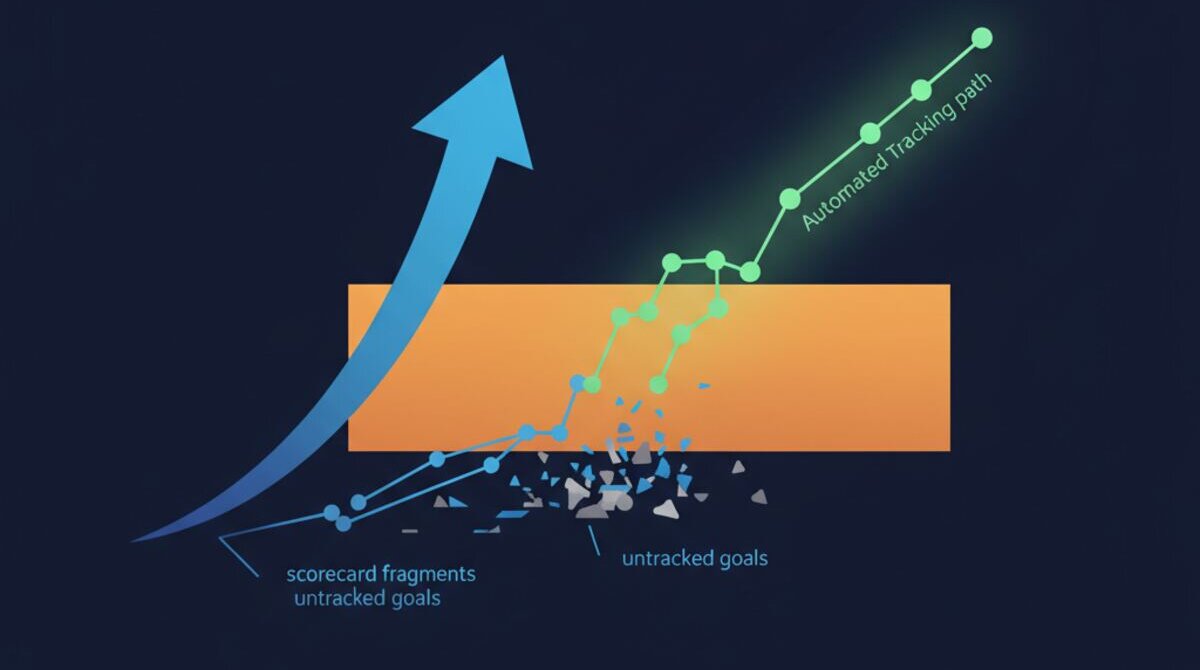
If you run your company on EOS — the Entrepreneurial Operating System — you know what a weekly scorecard is supposed to look like. Every manager, every week, has a weekly L10 meeting where they present their scorecards and review their rocks. It’s one of the most powerful frameworks in business. And it’s also one of the most painful to maintain.
Because here’s the thing about human beings: we are inherently biased against tracking things, especially when tracking reveals that we’re not performing well. Nobody wants to be the person who shows up to the L10 with red numbers. So what happens? People avoid it. They procrastinate on pulling the data. They round up. They present last week’s numbers because this week’s aren’t ready yet. The scorecard becomes a performative exercise rather than a strategic tool.
That’s the problem AI was born to solve.
The $37,800 Calculation Nobody’s Done
Let me walk you through some maths that will make you uncomfortable.
Take a company with 30 employees. Each person spends roughly 15 minutes a week updating their scorecard metrics — logging into systems, pulling numbers, updating spreadsheets, making sure everything is current for the weekly meeting. That’s a conservative estimate. Most people would say it takes longer, but let’s be generous.
15 minutes times 30 employees means you’re spending 450 minutes a week on scorecard maintenance across the organisation. Multiply by 4.2 weeks per month, that’s 1,890 minutes a month. Multiply by 12 months, that’s 22,680 minutes a year.
Divide by 60. That’s 378 hours your team spends annually just keeping scorecards current.
Now here’s where it hits: what’s the opportunity cost of those hours? If you value your people’s time at even $100 an hour — and for managers and senior staff, it’s typically much more — that’s $37,800 per year. Walking out the door. On a task that could be fully automated.
And that’s a 30-person company. Scale it to 90 employees and you’re spending $113,400 a year on manual scorecard tracking. For a 200-person company? You can do the maths yourself, but I promise the number will make you wince.
“We calculated that our team was spending over 400 hours a year on scorecard preparation. That’s ten full working weeks. When you put it that way, automating it wasn’t a nice-to-have — it was negligent not to.”
What It Actually Costs to Automate This
Here’s the number everyone wants to know: less than $10,000.
That’s what it costs to set up AI-powered scorecard tracking that replaces that entire manual workflow. We build small AI agents on top of the Ai1 platform, each one designed to connect to your existing tools, pull the relevant data, and generate scorecard reports automatically.
Compare that to the annual cost of doing it manually. For a 30-person company, you break even in about three months. For a 90-person company, the ROI is roughly 10x in the first year. And unlike a human analyst, the AI agent doesn’t take holidays, doesn’t round up, and doesn’t get nervous about presenting bad numbers.
How the Plumbing Actually Works
I want to demystify this because I think a lot of business owners hear “AI automation” and imagine something enormously complex. It’s not. The technology has become remarkably simple.
What we’re really doing is building little MCP and API connectors — think of them as plugging into the back door of all your software applications. A small, secure connection that lets the AI agent read data from your tools. QuickBooks, HubSpot, Google Analytics, Asana, Xero, Salesforce, Google Sheets — whatever you use, we build a connector for it.
Each connector is like a little pulse. It reaches into the application, grabs the relevant numbers, and brings them back to the AI agent. The agent then stores everything in a simple Google Sheets document — not because we need fancy infrastructure, but because Google Sheets is accessible, transparent, and something your team already knows how to read.
Once the data is collected, the AI agent runs the analysis. It doesn’t just compile numbers into a table. It reads them like a senior strategist would: cross-referencing financial performance with customer metrics, looking for correlations between process efficiency and growth, spotting early warning signs that would take a human analyst days to uncover.
Then it delivers the finished scorecard on a schedule. Every week, every fortnight, every month — whatever cadence works for your L10 meetings. It shows up in your Slack channel or your inbox on Monday morning, ready for the team to review. No manual effort. No login marathons. No broken spreadsheet formulas.

The Accountability Revolution
Here’s something that caught me off guard when we first deployed this: the accountability shift.
When scorecards are manual, there’s always plausible deniability. “I didn’t have time to pull the numbers this week.” “The system was down.” “I’m waiting on finance to send me the data.” These are all reasonable-sounding excuses, and managers hear them every week.
When the AI agent generates the scorecard automatically, those excuses disappear. The numbers are there. They’re current. They’re accurate. Nobody can hide behind process friction anymore. And the conversation in the L10 meeting shifts fundamentally — from “do we have the numbers?” to “what do the numbers tell us, and what are we going to do about it?”
That’s the conversation you actually want to be having. That’s where strategic value lives. Every minute your team spends gathering data is a minute they’re not spending acting on it.
The Layered Intelligence Opportunity
Once you have automated scorecard tracking in place, something interesting happens: you start seeing opportunities for deeper analysis that you never had the bandwidth to pursue before.
With the basic plumbing in place, the same AI agents can layer on competitive analysis — pulling publicly available data about your competitors and benchmarking your performance against the market. Industry analysis that tracks sector trends and positions your metrics in context. Pricing analysis that correlates your pricing changes with customer acquisition and churn patterns. NPS deep-dives that go beyond the top-line score to segment-level insights. Employee satisfaction tracking that connects culture metrics with operational performance.
None of this was practical before because the foundational data collection was eating all your bandwidth. Once the scorecard runs itself, your strategic analysis capacity is effectively unlimited.
Where This Goes Next: The Strategy Automation Stack
Scorecard tracking is just the first layer of what we’re building at MyZone AI. Once you have automated KPI collection and analysis, the natural next steps open up:
Rock accountability tracking — your quarterly rocks in EOS, automatically tracked against milestones and flagged when they’re falling behind. Rock alignment analysis — ensuring your rocks actually ladder up to your strategic objectives, with AI cross-referencing outcomes against stated goals. Roadblock analysis — AI that identifies patterns in recurring issues and suggests systemic fixes rather than one-off workarounds.
Quarterly meeting prep — instead of spending two days assembling board decks, the AI generates a comprehensive quarterly review with trend analysis, forecasts, and recommended focus areas. Annual planning support — historical trend analysis, scenario modelling, and strategic recommendation engines that draw from your actual performance data rather than gut feel.
AI readiness assessment — a continuous evaluation of where your organisation is in its AI maturity, what the next highest-value automation opportunity is, and what capabilities you need to build. Deep research automation — AI agents that conduct market research, competitive intelligence, and trend analysis on demand.
Each of these builds on the same foundation: AI agents connected to your business tools via secure API connectors, running scheduled analyses, and delivering insights where your team actually works. The scorecard is the starting point because it’s the most universal need, but the stack grows from there.
The Small Business CEO With Coca-Cola Capabilities
Here’s what excites me most about this moment: for the first time in history, a 30-person company can have the same strategic intelligence capabilities that used to be reserved for Fortune 500 enterprises with massive analytics departments.
Coca-Cola has hundreds of analysts tracking scorecards, running competitive analyses, modelling scenarios. A small business owner has… themselves. Maybe a bookkeeper and an Excel spreadsheet. The gap between what large enterprises could track and what small businesses could track was enormous.
AI eliminates that gap. Not partially — almost entirely. The same analytical rigour, the same cross-perspective insights, the same predictive capabilities. For less than $10,000 in setup costs and a fraction of the ongoing expense.
That’s not an incremental improvement. That’s a fundamental shift in competitive dynamics. And the businesses that move first will have a compounding advantage that becomes very difficult to overcome.
The Window Is Open. It Won’t Stay Open.
Right now, only about 5 to 10 percent of businesses have started using AI for strategic planning and scorecard tracking. The cost of these capabilities has dropped roughly 100x in the last two years. What used to require a team of data scientists and six-figure budgets can now be done with a few AI agents and some API connectors.
This will become mainstream. Within two or three years, automated scorecard tracking will be as standard as having a CRM. The question isn’t whether your competitors will adopt this — it’s whether you’ll be ahead of them or behind them when they do.
Every week that your team spends 378 hours a year on manual tracking is a week your competitors might be spending on strategic action instead. The early movers aren’t just saving time — they’re building an intelligence advantage that compounds quarter after quarter.
If you are not using artificial intelligence in your strategic planning now, consider yourself warned. The technology is here. The cost is negligible compared to the alternative. And the businesses that wait will find themselves trying to catch up to competitors who’ve had two years of AI-powered strategic insights that they didn’t.
And if you want to see what it would look like with your data, book a free consultation. We’ll connect your tools, generate your first scorecard, and show you exactly what AI-powered strategy tracking looks like for your business.
The scorecard was always the right framework. It just needed the right engine. Now it has one.
See the Scorecard Tracking Automation in Action
Watch how Ai1 builds and tracks balanced scorecards automatically with our scorecard tracking automation workflow.
Explore the Automation →