Past Workshop / July 16, 2026
Agentic Development Best Practices, Part 1 — 16 Jul 2026
Last updatedMost people building agents today are vibe coding. Type a prompt. Hope for the best. Ship something fragile. It works until it doesn't. Then you're rebuilding the same automation for the fourth time. There's a better way. We call it agentic development. It's the disciplined pipeline MyZone runs across 200+ production automations, and Mike Schwarz covered it in this session.
- A free online workshop held with Mike Schwarz on July 16, 2026, 9:00 to 10:30 AM PT.
- It teaches agentic development: the disciplined 7-stage pipeline MyZone runs across 200+ production automations.
- Topics include modular skills, requirements and scoping, memory systems and model selection.
- For operators, founders, marketers and developers who want a repeatable system instead of one-off prompts.
- Replay access and Q&A with Mike were included for original registrants.
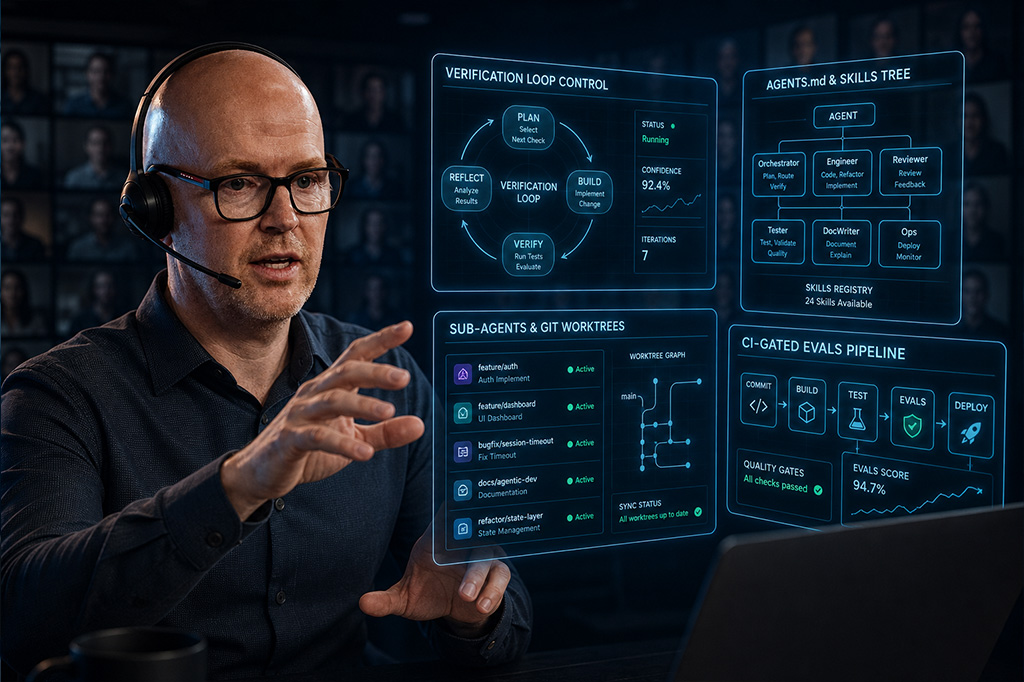
| Detail | Agentic Development Best Practices, Part 1 — 16 Jul 2026 |
|---|---|
| Date | July 16, 2026 |
| Time | 9:00 to 10:30 AM PT |
| Format | Online session with Q&A with Mike (ended) |
| Cost to attend | Free for live attendees |
| Replay | Included for original registrants |
Why This Matters
Why do most AI agents stop working after the demo?
The barrier to building an AI agent has collapsed. Ten minutes with Claude or GPT-5.5 and you've got an agent that drafts proposals, enriches leads, or summarizes meetings. Getting it working once is the easy part. Getting it to keep working is the hard part. New edge cases. New models. New team members. The slow drift that creeps into every long-running automation.
Most teams discover this the painful way. The agent that demoed beautifully in week one starts hallucinating in week six. The quick win becomes the brittle script nobody wants to touch. The library of half-finished agents grows. Trust collapses. The team quietly goes back to doing the work manually, because at least manual work doesn't lie.
The teams winning at this aren't the best coders. They're the ones who treat agent-building like an engineering discipline. Pipeline. Verification. Memory systems. The patience to plan 90% and build 10%. This workshop teaches you that discipline, from a team that's deployed it across 200+ production automations.
What You'll Learn
What will you learn in Part 1?
Part 1 is for anyone building or using agents:
- Operators
- Founders
- Marketers
- Developers who want a repeatable system instead of one-off prompts
The 7-Stage Agentic Pipeline
A repeatable framework covering every phase from requirements through deployment — so nothing falls through the cracks.
Agentic vs. Vibe Coding
The mindset shift that separates agents that last from ones that break. Why discipline beats speed every time.
Modular Skills Architecture
How to break work into reusable, composable components that scale — and don't collapse when you change one thing.
Requirements & Scoping
How to define specs through iterative passes so your agents know exactly what success looks like before they start.
Memory Systems
The AGENTS.md pattern that reduced token overhead from 50,000 to 6,000 — and made agents dramatically more reliable.
Model Selection Strategy
When to use different Claude and GPT tiers — and how the wrong choice silently tanks your agent's performance.
Who It's For
Who is this workshop for?
You're already using agents
And you keep rebuilding the same automation because the last version got messy.
You're building skills or recipes
And you want a framework for designing them so they recycle across projects.
You lead a team adopting AI
And you need a system your operators can follow without becoming engineers.

Mike Schwarz
CEO, MyZone AI
Mike designed the internal pipeline framework that powers MyZone's entire agent suite. He's spent the last three years pioneering the modular skill-recipe methodology — a system built out of necessity, tested across hundreds of production automations, and refined through over 40 workshops with thousands of attendees.
This event has ended
Every hour spent learning the pipeline saves a week of debugging a brittle agent. This is the same framework MyZone runs internally. This event has ended. Live attendance was free, with replay access and Q&A with Mike included for original registrants.
This event has ended
This event has ended. Registration is closed.
Don't Take Our Word for It
Trusted by leaders at Plastic Bank, Outback Team Building, RMG Advertising, Keeran Networks, and Titan Training Centre